Meet a deadline
You have more work than one node can finish in time. Go wider.
Mount beats copy at every width
The claim to test: mounting lets you go wider without the data-plane cost that
copying pays per node. Measured — flagstat over 64 CRAMs (535 GB) across 1, 8,
and 64 c8g.2xlarge spot nodes, lith-mount vs stage-to-gp3
(#83):
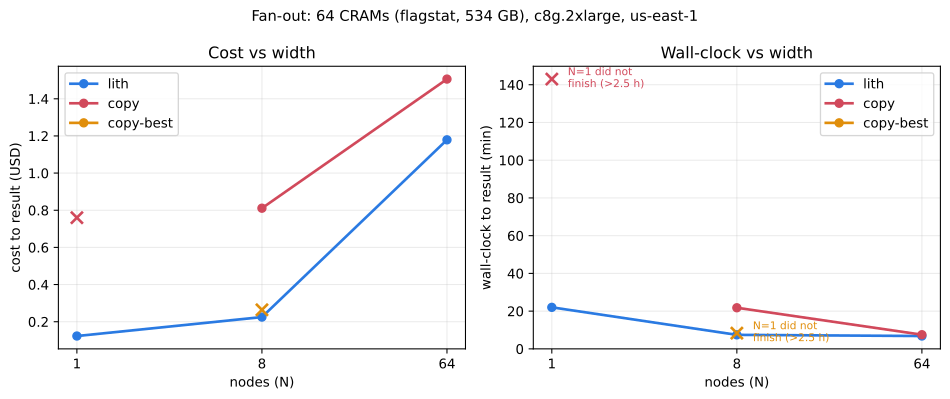
lith is both cheaper and faster than copying at every width. At N=1, one node finishes the whole job through lith in 22 min for $0.12, while the copy path can't even finish staging the 535 GB in the 2.5-hour budget (its stage alone, ~72 min, exceeds lith's entire run). At the sweet spot N=8 — where the file count matches the cores, so every vCPU is busy — lith is 2.9× faster and 3.6× cheaper (7.4 min / $0.23 vs 21.8 min / $0.81). Copying pays for staging lith never does — serial in front of compute, then read back from a 125 MB/s volume — so it loses on both axes, everywhere.
Given the copy path its best tool and tier — s5cmd staging to a 1000 MB/s
gp3 (the copy-best line) — the N=8 gap narrows a lot: ~8.3 min / ~$0.26,
roughly 2.6× faster and 3× cheaper than the naive copy. lith still edges it
(7.4 min / $0.23), because even at ~1 GB/s a node must finish staging its shard
before it computes, while the mount overlaps the two. The fast-copier result is
the honest one to plan against: the mount's fan-out advantage is real but
modest once the copier is well-chosen.
Two honest caveats the chart shows. Cost is not flat across width: it rises
with N for both paths, because a fixed per-node boot-and-setup cost is paid N
times and, past the sweet spot, each node underuses its cores (at N=64 each node
runs one flagstat on 8 vCPUs). And wall-clock floors once you pass
N ≈ files ÷ vCPUs: from 8 to 64 nodes the wall barely moved while cost grew ~5×.
So the rule for going wide: fan out to about files ÷ vCPUs-per-node, not
further. There you get full CPU utilization, the shortest wall-clock, cost near
its floor — and lith's staging-free advantage over copying at its largest. Wider
than that spends more for no speed-up; copying loses at any width.
How to do it
Fan out with an instance array, one lith mount per node, each node reading its own shard by key range. No shared state, so nothing coordinates and nothing contends:
# One node's job, parameterized by shard index (0..N-1) of N.
# The index defines a key range; the node mounts and processes only its shard.
lith mount s3://your-bucket/dataset /mnt/data \
  --index-file /tmp/dataset.lithidx --daemon
process-shard /mnt/data --shard "$SHARD_INDEX" --of "$N_SHARDS"
fusermount3 -u /mnt/data
Launch N of them as an array (e.g. spawn array), each with its own
SHARD_INDEX. Points that make this cheap and safe:
- Shard by key range, not by copy. Each node's
process-shardwalks the keys assigned to its index. lith serves every node's metadata from the local index and fetches only the objects that node reads. - No shared filesystem. There is nothing to provision, size, or tear down between the nodes; each mount is independent and local to its node.
- Spot-safe. Nothing durable lives on the node — no staged copy to lose — so a reclaimed spot instance costs only its in-flight shard, which the array reschedules. This is what makes width cheap: you can run the whole fan-out on interruptible capacity.
- Build the index once, reuse it N times. Build the
--index-filein the launcher and hand the same file to every node (or let each node auto-build for a small prefix); the listing cost is paid once, not per node.
Prebuild the index in your launcher, distribute it with the job, and each node starts reading immediately with zero metadata round-trips.
See your spore.host cookbook's job-arrays pattern for the launcher side (array submission, per-index parameters, spot retries).